
Customer Overview
Nussbaum Transportation is a nationally recognized carrier known for its commitment to sustainability, innovation, and operational efficiency. The company continually explores new technologies to improve vehicle performance, reduce idling, and lower maintenance costs. As part of this mission, Nussbaum partnered with PowerFilm to conduct an extensive, real-world test comparing solar panel technologies on Freightliner tractors equipped with electric auxiliary power units (EPUs).
Challenge
Nussbaum wanted to determine which solar panel solution offered the best overall performance and cost-effectiveness under real-world over-the-road conditions. The test compared PowerFilm’s 440W Freightliner solar panels with a competitor’s 500W solar panels to evaluate power generation, charging efficiency, and return on investment across real-world geographic and weather conditions.
Test Setup
To ensure accurate and unbiased data, Nussbaum assigned four Freightliner tractors with high-resolution data-logging systems for this testing:
- Two trucks with PowerFilm 440W Freightliner solar panels and charge controllers.
- Two trucks with the competitor’s 500W Freightliner solar panels and charge controllers.
Each system included several performance measurement and tracking components:
- A 300A Victron current shunt to capture current from the solar panels to the EPU batteries, and capture the voltage of the EPU batteries.
- A Victron Cerbo GX data logger collecting readings every 15 minutes throughout the test period.
- Cellular connectivity for real-time data uploads and an onboard SD card for backup storage.
- A GPS antenna integrated into each Cerbo GX to track truck location and correlate solar performance with regional and weather variations.
Data was logged continuously from March 1, 2025, through February 28, 2026, covering multiple routes and environmental conditions. Victron’s web portal was used to review and export data from each vehicle.
Test Conditions
The testing period we report covers March 1, 2025, through February 28, 2026. During this time, each truck experienced seasonal variations in weather and sunlight, as well as real-world driving and power consumption. This made it an ideal scenario for measuring panel performance across multiple seasons. Both systems were exposed to all daylight hours, weather types, and truck orientations during the testing period.
Results: PowerFilm Provides Superior Power Output
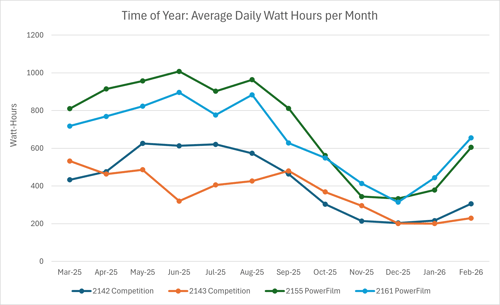
Over the test period, data was collected at 15-minute intervals, with each truck recording over 23,000 data points. This data was then integrated using the rectangular method to estimate the watt-hours of power collected for each truck in each month. During the period when all four trucks were collecting data, PowerFilm’s 440W solar system outperformed the competitor’s 500W solution, delivering more than 1.74 times the power in watt-hours to the EPU battery pack. This value represents actual, measured power supplied to the batteries and is not adjusted for the panels’ rated wattage.
The average daily watt-hours for the PowerFilm system were 686 Wh, and for the competing system, 395 Wh.
Test Locations and Routes
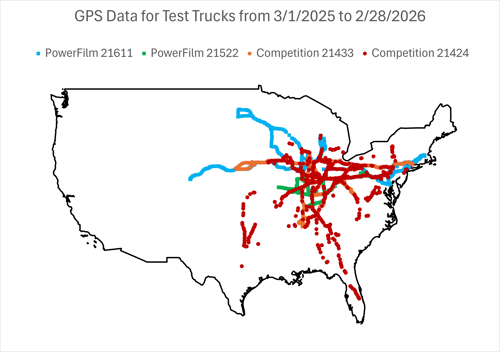
GPS tracking confirmed that both test vehicles operated within similar regions, ensuring fair geographic and weather exposure. This helped validate that performance differences were attributable to panel quality and technology rather than to operational conditions.
Key Findings
- PowerFilm’s 440W system delivered 74% more power than the competitor’s 500W solution.
- Real-world data showed that the PowerFilm panel’s durability and optimized electrical configuration contributed to PowerFilm’s stronger performance across all conditions.
Conclusion
Nussbaum’s fleet test demonstrated that PowerFilm’s solar panel technology delivers measurable advantages over the competitor’s panels. The 440W PowerFilm panels delivered higher average power to the truck’s battery system than the competing 500W solutions.
Fleets adopting lightweight and durable solar solutions can expect:
- Increased usable power in all weather and geographic conditions.
- Improved EPU battery uptime and longevity.
- Reduced maintenance costs and fewer jump-start events.
Leveraging real-world fleet data, the Nussbaum test demonstrated that PowerFilm’s solar technology outperforms higher-rated systems and delivers value and reliability where it matters most, on the road.